Author Archives: Bill Frederick
Art at the Maine Lobster Festival

Investigative journalism: Campaign contributions
Reporters are always looking for stories like this, but I don’t remember how I found this one. I do remember that I was not the regular State House Reporter for UPI and that I had been sent over there for the day to cover for the regular beat reporter, who was out sick. There were probably 30 or 40 regular beat reporters covering the Massachusetts State House back then, and I don’t recall how I got this story exclusively. This wasn’t the story of the year, but it was pretty good and it made every Massachusetts daily newspaper the next day, including the Boston GLOBE. That was pretty cool because the Globe had a four or five-person State House bureau, and getting something in their own paper that they didn’t have was something of an achievement.
McCann may have broken campaign laws
EXCLUSIVE
By ARTHUR FREDERICK
BOSTON (UPI) – Sen. Francis X. McCann of Cambridge has attributed $12,698 in campaign contributions to the “McCann Reception Committee,” which he claims is a non-political group. The move appears to violate state law.
State law states candidates are required to file lists of campaign contributions and expenses with the state Elections Division. The law’s purpose is to make available to the public information on where a candidate’s money comes from and where it goes.
Of the $13,473 contributed to McCann’s primary campaign, only $775 is attributed to contributors other than the McCann Reception Committee.
Secretary of Public Records Andrew R. Sigourney said Wednesday his office would turn the matter over to the Attorney General’s office if McCann did not disclose the names of his contributors.
Reached Wednesday night, McCann acknowledged that he considered the McCann Reception Committee to be a non-political group.
“This was a testimonial dinner for me,” he said. McCann said he didn’t remember when the dinner was held but said he thought it was “sometime last spring.”
McCann filed his list of contributors with the Elections Division, but that office returned it with a note requesting the names of the contributors to the McCann reception Committee.
McCann wrote back, saying he could attribute the $12,698 only to the McCann Reception Committee because the group was “non-political.”
Sigourney said the Department of Public Records considered the move in violation of the law and would ask McCann again to comply. He said the matter would be turned over to the Attorney General’s Office if he refused.
McCann said he still had the names of those persons who bought tickets to the testimonial. “Thank God we didn’t throw anything out,” he said.
According to law, candidates can list contributions from non-political groups and name only two officers of the group. But Sigourney said the state considered a non-partisan group to be “as labor union or something like that.”
“He’d reported a sum of money as coming from the association,” Sigourney said. ”When gifts are made by an association, we require names and addresses of two principal officers, as required by Chapter 55, Section 88 of the General Laws.”
“However, he (McCann) claims as an association what we interpret to be a political committee,” he said.
McCann, a Democrat, has been a member of the Massachusetts Senate since 1955.
Dog stories II: Bruiser the police dog
This is a good example of the “there’s a good story almost everywhere if you look for it” school. I found out about Bruiser by doing a Google search after finding his grave in a pet cemetery. I wrote the story for my wife’s real estate blog.
Bruiser the German Shepherd did not have what you may think of as an auspicious beginning. His first owner got rid of him because he bit somebody.
 A dog who bites people would probably not be accepted today as a good police dog candidate. But back in the early 1970s, things may have been a bit looser. The St. Petersburg Police Department wanted to start a canine unit, and Bruiser was available. So that’s what happened – Bruiser became the city’s very first canine officer in the early 1970s.
Officer Bill Trappman became Bruiser’s handler, partner and friend. Together, they rescued a little girl in what was one of the decade’s biggest local crime stories.
In June of 1972, Trappman and Bruiser were called to a home near Booker Creek. An hysterical woman told Trappman that a man had broken into her home and kidnapped her two-year-old daughter.
Bruiser immediately picked up the trail, even though a recent rain had made tracking very difficult. In just a few minutes, Bruiser led Trappman to nearby Booker Creek, and Trappman’s flashlight beam picked up the sight of a man who was slamming the little girl against a tree trunk.
The man tossed the little girl in the creek and then jumped in himself. Trappman went after the girl, while Bruiser pursued the man. The girl survived the incident, and the man, a former convict who had recently been released from prison, went back to jail.
Trappman gave all the credit to Bruiser.
“He was everything,” Trappman said later in the St. Petersburg TIMES about his canine partner. “I was just the dummy on the end of the leash. He was the best partner I ever had and the best cop I ever knew.”
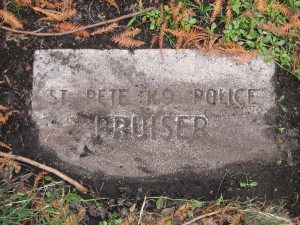 Bruiser was eight years old when all that happened. Four years later, when he was 12, the pain in his legs and hips got so bad that Trappman realized the time had come. He carried Bruiser to the vet’s, and he was put to sleep.
According to Trappman, Bruiser sniffed out more than 14,000 pounds of narcotics during his career, and helped send 127 criminals to prison.
* * *
On the day after Christmas, we decided to tour Green Mounds Pet Cemetery, a nearly forgotten pet cemetery behind Fletcher’s Harley-Davidson on US19 in Clearwater. The Fletcher family now owns and cares for the cemetery, having taken title to it when they bought a large tract of land behind their motorcycle dealership.
On the farthest corner of the cemetery, in the shade of a tree, we saw a statue of what looked like a German Shepherd dog. As we approached and then scraped the dirt from the closest grave marker, we saw the name “Bruiser.” Another line said, “St. Pete Canine Police.”
Bruiser’s grave is surrounded by a number of other St. Pete Police canines, perhaps 10 or so. They watch over a peaceful and well-cared-for tract that is the final resting place of several hundreds of pets, mostly dogs and cats but also a pony named Twinkles, who has her own fenced plot.
Ibises and moorhen

Speechwriting
I didn’t have much speechwriting experience when I went to work in the U.S. Senate, but I did have a leg up on most people because I had loads of experience at writing news for broadcasters. At UPI, I spent many work shifts on the broadcast desk, writing news for radio newscasters. “Writing for the ear,” we called it. As it turned out, “writing for the ear” applied perfectly to writing speeches – it even used the same punctuation – three dots instead of commas, for example, no abbreviations and no capitalization. Or, more accurately, ALL capitalization. The idea was to make the copy as easy to read as possible since the speaker would be reading the words out loud with little opportunity to try to figure out complicated syntax or sentence construction. Senator William Hathaway, my boss, delivered this speech to the Young Democrats State Convention in Augusta, Maine. The theme – the ability to accept divergent views – was no accident. He was getting hammered by young people, many of whom were staunch environmentalists. Why? Because he was a longtime advocate of the Dickey-Lincoln Hydroelectric project – a project favored by labor because of the jobs it would have created, but opposed by many environmentalists because of the thousands of acres of forest land that it would have destroyed. By the way, that project was ultimately abandoned.
IT IS ALWAYS A PLEASURE FOR ME TO APPEAR BEFORE A GROUP OF YOUNG PEOPLE – ESPECIALLY YOUNG DEMOCRATS. I SINCERELY BELIEVE THAT YOU ARE THE LIFEBLOOD AND THE FUTURE OF THE DEMOCRATIC PARTY.
I HOPE THAT THERE WILL BE AN HONEST AND FRANK EXCHANGE OF OPINIONS BETWEEN US TODAY. I ALSO HOPE THAT YOU WILL ASK QUESTIONS AND… ON MY PART… I PROMISE TO EXPRESS MY VIEWS AS CANDIDLY AS POSSIBLE.
MOST IF NOT ALL OF YOU HERE TODAY CANNOT REMEMBER WHAT IT WAS LIKE TO BE A DEMOCRAT IN MAINE 25 YEARS AGO. THE DEMOCRATIC PARTY IN MAINE WAS PRACTICALLY NONEXISTENT. WE WERE FEW IN NUMBER AND OUR INFLUENCE WAS NEGLIGIBLE. THE ENSUING TWO DECADES WAS A CLEAR STORY OF SUCCESS. AFTER NEARLY A CENTURY AS A MINORITY THE DEMOCRATIC PARTY OF MAINE CAME TO DOMINATE THE POLITICAL STRUCTURE OF THIS STATE. WHILE CHANGING THE FACE OF POLITICS IN MAINE WE MANAGED TO IMPROVE THE LIVES OF MANY MAINE PEOPLE.
I BELIEVE WE WERE SUCCESSFUL IN THAT EFFORT BECAUSE WE WERE WILLING TO WORK TOGETHER AND TO HELP EACH OTHER. WE WERE WILLING TO OVERLOOK THE ISSUES THAT DIVIDED US AND INSTEAD LOOKED TO THE ISSUES THAT UNITED US. WE LISTENED TO EACH OTHER, AND WE CARED ENOUGH ABOUT WHAT WE WERE DOING TO WORK TOGETHER AS A TEAM.
IT WASN’T ALWAYS AN EASY TASK. BUT WE NEVER LOST SIGHT OF OUR PURPOSE – TO MAKE MAINE AND THIS NATION A BETTER PLACE FOR ALL CITIZENS TO LIVE AND WORK… AND NOT JUST FOR THE WEALTHY AND THE WELL-TO-DO.
OVER THE YEARS, THE DEMOCRATIC PARTY OFFERED THE VOTERS GOOD CANDIDATES, GOOD PROGRAMS AND A GREAT DEAL OF IMAGINATION. WE DELIVERED ON OUR PROMISES, TO THE BENEFIT OF THE VAST MAJORITY OF MAINE PEOPLE. AS A DEMOCRAT, I AM PROUD OF OUR ACCOMPLISHMENTS AND YOU… AS THE SUCCESSORS TO THIS DEMOCRATIC TRADITION… CAN BE PROUD TOO.
BUT WE MUST CAUTION OURSLEVES AGAINST COMPLACENCY. THE TRIUMPHS OF THE PAST CANNOT BE RELIED UPON ON TO GUARANTEE OUR VICTORIES IN THE FUTURE. TO YIELD TO THAT TEMPTATION IS TO INVITE DEFEAT. OUR PARTY WILL NOT BE JUDGED BY ITS PAST PERFORMANCE… BUT RATHER BY ITS PRESENT POLICIES AND BY ITS FUTURE PROPOSALS.
BUT TODAY I WOULD LIKE TO SPEAK TO YOU OF A SECOND DANGER THAT THREATENS THE DEMOCRATIC PARTY.
SOMETHING COMPLETELY DIFFERENT: Restaurant reviews
How did restaurant reviews get into the writing mix? Beth and I like to go out to eat and we do so a lot. We thought that some restaurant reviews might be a good change of pace for the real estate blog, so I started making that a part of the go-out-to-eat routine. Sometimes I’d forget, but other times I’d grab a quick picture and dash off a few paragraphs. This one was about Peggy O’Neill’s, an Irish pub in the old historic part of downtown Palm Harbor.
I’m not a huge fan of the Irish pub/pub food concept, but there are times when nothing but a good burger or some fish and chips will do. And when that moment strikes, Peggy O’Neill’s in old downtown Palm Harbor really fits the bill.
There are a few important items to mention about Peggy O’Neill’s:
 First, Peggy O’Neill was supposedly a young Irish woman who immigrated from Ireland to America in 1912, expecting to reunite with her fiance and get married. Unfortunately, the ship she chose for her trip was the Titanic. More than 1,000 survived the sinking of the Titanic, but Peggy wasn’t one of them.
Another item of interest: Peggy O’Neill’s is located in the old Sutherland building at 1026 Florida Ave. in old Palm Harbor, close to Alt. 19. That old building is pretty interesting from an architectural viewpoint, and the old post office trappings have been left alone in what is now the dining room.
The corned beef and cabbage is worth trying; so is the fish & chips. I had a reuben sandwich on a recent trip, and that was excellent, as well. One of our companions tried the Shepard’s Pie, and said it was great.
Like most Irish pubs, Peggy O’Neill’s is casual and fun. The waitpeople are friendly and helpful, and kids seem to be welcome. There’s live entertainment on Fridays and Saturdays, and Wednesday night is open jam night.
Writing about local issues
This piece was written for the real estate blog. Most of the items posted on that blog were more light-hearted than this one, but we felt that Tampa Bay desperately needs a light rail system. When we used a light rail system in Baltimore while we were on vacation, we were inspired to post this opinion piece on the real estate blog. It got some good reactions, including a nice thank-you from the people who run light rail in Phoenix.
Tampa Bay scores again; Forbes Magazine took a look at the 60 major metro areas in the country and then rated their rapid transit systems. Tampa Bay made the list — in last place.
That should come as only a mild surprise to anyone who has had to drive to work on either side of Tampa Bay. Traffic here is a nightmare, and there are few alternatives to driving your own car to work. We do have a bus system, but there is no rapid transit system, no subway, no passenger rail.
 Many of our major roadways started life as sleepy two-lanes. US19N, the major north-south road that runs the length of Pinellas County, was once a rural two-lane road that passed through miles of orange groves, at least in the northern part of the county where I live. Someone recently told me that he remembered when there was just a flashing light at the intersection of 19 and Tampa Road, a busy major intersection today that serves six lanes of US19 and four of Tampa Road.
If you want to cross the bay between Pinellas (Where St. Petersburg is located) and Hillsborough (Tampa), you have four choices: The Gandy bridge; the Howard Franklin Bridge; the Courtney Campbell Causeway; and Hillsborough Avenue, the only land route, located at the northern tip of Tampa Bay. If you attempt this crossing in rush hour, be prepared to sit.
If you’ve read this blog before, you know I am a fan of light rail, and we might — just might — have such a system in our sights.
A month or two ago, President Obama came to town and announced that the federal government would fund the majority share of a high-speed rail line between Tampa Bay and Orlando. That’s nice, because it would eliminate the drive on I-4, a really difficult bit of Interstate between those two cities.
But the real value of such a line would be the possibility of a light rail system at this end of it. The high-speed line could connect to a light-rail system that would circumnavigate Hillsborough and Pinellas Counties and provide an alternative to the automobile.
We have something called the Tampa Bay Area Rapid Transit Authority (TBARTA), which would like to build that system. Clearwater Mayor Frank Hibbard, who serves on the TBARTA board, spoke at St. Petersburg College recently about rapid transit in Tampa Bay, and said such a system is necessary both for current residents and to respond to companies that may consider locating facilities in Tampa Bay.
All that said, I do have a bone or two to pick with Forbes about this ranking. We used to live in Washington, DC, and it would be hard to imagine a worse commuting city than that. Before we lived in Florida we lived in Maine, and that meant the occasional drive to the biggest metro center in that neck of the woods, Boston. If you’ve never driven in Boston at rush hour, it is a breathtaking experience. Still, both those cities have good subway systems and buses that run frequently.
I think it is fair to say that Palm Harbor real estate, Dunedin real estate, or Pinellas County real estate in general would be more attractive if it was served by an efficient light rail system
Feature writing: Hockey at Frog Forum
I think that the very best feature stories are simple ones. I loved this story about a homemade skating rink, and how it bonded two generations of a family. For years I thought this story had been lost, and I was delighted to find it in one of my clip files.
Frog Forum’s last hockey game
By ARTHUR FREDERICK
WATERVILLE, Maine (UPI) – Kyle Frewin welcomed the new year just as he has every year since he was a kid – playing hockey all night with the neighborhood kids on the home-made rink behind his parents’ house.
This could be the final year for the rink, named Frog Forum so many years ago that no one quite remembers why. The New Year’s hockey game that extended well into Tuesday morning could be the last.
Kyle, 21, the youngest of four Frewin sons, will graduate in the spring from Gordon College in Massachusetts. His father, Ron, lost his job months ago and wants to sell the house and move to Arizona. If that happens, there will be no more Frog Forum.
Frog Forum began humbly, a modest backyard rink banged together out of three-foot boards in 1961 by Ron, who wanted to share his love for hockey with his boys.
Over the years, the rink behind the Frewin’s house grew larger.
First, it claimed a few trees and shrubs. Then the Frewins made more room by ripping up part of the driveway. Eventually, even Louise Frewin’s clothesline was ripped down to make room for more ice.
The Frewin boys grew bigger, and so did the neighborhood kids who skated at Frog Forum. Hockey pucks flew over the boards and into the neighbors’ yards. The youngsters played past sundown, groping for the puck in the darkness.
Ron installed six-foot boards to keep the puck on the ice. He installed lights so the kids could play all night if they wanted to.
Down the street, a group of youngsters formed a hockey team called the Scummies. Ron turned on the lights, and Frewins and Scummies banged each other happily into the boards.
“We’ve had broken teeth, pucks that have split eyes and heads, injuries from when the kids got banged into the boards,” Louise Frewin said. “They all watch television, and they all have to play as rough as the Bruins.”
This year, with Kyle in school and Ron suffering from arthritis, Frog Forum almost stayed stacked up in the garage. But Kyle wanted one more New Year’s.
“Kyle begged us to put it up once more,” Louise said. ”And Ron said to me, ‘How can the neighborhood kids ever learn to play hockey if they don’t have Frog Forum?’”
The Frewins went to church New Year’s Eve and afterwards, at around midnight, Kyle and a dozen neighborhood kids laced up their skates and started to shoot the puck around the ice.
“I went to bed, but I could hear that puck banging into the boards all night long,” Louise said.
The oldest Frewin son, Donn, died in a swimming accident eight years ago. Paul is a doctor in Louisville, Ky. Wesley is an electrical engineer in Connecticut.
With everyone gone, Frog Forum seems doomed. But Louise thinks Kyle might have other plans.
NOTE: This story ends rather abruptly and I think the newspaper editors may have trimmed it to fit an available space in the page. If I ever find a complete version of it, I’ll add the missing paragraphs.
UPDATE 1/20/2015: I came across another version of this story quite by accident and, sure enough, there was one additional paragraph in the original version, which makes the story end a bit less abruptly. Here it is:
“What he wants to do is become a history teacher right here in Waterville,” she said. “And he wants us to leave him the boards when we move to Arizona.”
Pelican St. Petersburg, Fl.

 Bill Frederick's portfolio