
Monthly Archives: April 2014
Candle brochure

A friend of mine owns a candle-making business. I did the photos for her website.
And now for something completely different…
My background is primarily in journalism, but I’ve spent a fair amount of time as a copywriter, churning out PR and ad copy on behalf of all kinds of clients. One of the ad agencies I worked for represented a snowshoe manufacturer, SnoCraft Corporation of Norway, Maine, a company that started around the turn of the last century but which now appears to be out of business. The following feature story was part of a press kit we put together for SnoCraft retailers — we hoped they would attach the names of their own businesses to this piece and then distribute it to local news media. This project was a bit out of the ordinary, but I do remember having some fun researching the history of snowshoes and then trying to come up with a snappy lead. I also recall that I carefully left out any reference to what French Canadians refer to as “mal d’raquette” — pain in the legs and ankles that develops from too much snowshoeing.
Snowshoes: Their history, uses, and where to buy them
Snowshoes help expand winter horizons
NORWAY, Maine – If it hadn’t been for the snowshoe, America might never have been discovered.
No, Christopher Columbus didn’t wade ashore in the New World while wearing snowshoes. But the aboriginal peoples who were the first settlers of North America were probably wearing snowshoes thousands of years ago when they crossed the land bridge over the Bering Strait from Asia.
While many think of snowshoes as something identified with Eskimos, those Artic peoples have actually had little use for snowshoes — most of their travel is over ice and wind-packed snow, making snowshoes unnecessary.
It was the North American Indians of the more temperate climates who really refined the snowshoe from a primitive branch-and-bark device to a sophisticated method of winter transportation.
But the history of the snowshoe goes back far beyond the history of North America. Snowshoes allowed early man to move northward in Asia and into northern Europe, Scandinavia and Siberia.
Many historians believe that the invention of snowshoes ranks with the wheel in its importance to the development of mankind.
Investigative journalism: The story of David Riggs
Some newspaper people believe that ALL journalism is investigative journalism. There’s some truth to that. But stories like this one are different and require much more work than most. This particular story was about a very unusual man who got himself in trouble over and over again as he pursued big dreams, many of them not exactly legal. It required weeks of work and many interviews. I found out recently that the man, David Riggs, died a couple of years ago, plunging his jet plane into a lake in China. Things hadn’t changed very much for him. For what it’s worth, I’m very proud of this story, which I wrote for the Tampa Bay Business Journal. You better go get a cup of coffee, it’s REALLY long…
-0-
By ARTHUR FREDERICK
Staff Writer
A convicted bank swindler who says he moved to Tampa to start a new life in the video post-production industry has left a trail of unpaid bills, angry suppliers and disillusioned business associates.
In the three years since David Riggs came to Tampa from Atlanta, he has become involved in at least three post-production companies. In doing so, according to people close to Riggs’ business interests, he has allegedly cost investors and suppliers thousands of dollars — allegations he denies.
His current company, Digital Majik Post Productions Inc., does work for a number of advertising agencies and other clients, including Tampa-based Paradigm Communications, one of the Bay Area’s largest ad firms.
Many clients speak highly of Riggs’ editing abilities and the way he showers them and prospects with attention, including gifts.
But suppliers and former associates paint a different picture — they describe Riggs, who has spent time in U.S. and Hong Kong prisons, as a manipulating figure who takes their money and property and then leaves them holding the bag.
“I hope someone catches up with that rat so he will just go away,” said one former supplier who claims he was left holding an unpaid bill worth several thousand dollars.
According to various people, Riggs has claimed to be the recipient of Emmy and Clio awards; to have done work for such major clients as Mitsubishi Electronics; to have been the author of the “This Bud’s For You” slogan; to have served as a backup member of the U.S. Olympic skeet shooting team, and to have played the trombone in the Ringling Bros. Barnum and Bailey Circus band.
Newspaper writing: People stories
One of the first things you learn at any newspaper is that stories need to be about people. You can write about places and things all day long, but the best stories describe how places and things affect people. Or a person. One thing I like about living in Florida is that it is filled with old people. And old people have lifetimes of experiences that make for good stories.
-0-
By ARTHUR FREDERICK
CLEARWATER, Fla. — Bill Wynne finally got his medals Thursday, 48 years after a Japanese rifleman shot him in the knee during a battle in the Philippines.
If Wynne hadn’t been so determined to get a special Florida license plate for wounded vets, he might never have gotten his decorations at all.
Wynne, 70, who lives at the On Top of the World development in Clearwater, spent part of Veterans Day at a ceremony at American Legion Post 7, collecting the Purple Heart and Bronze Star, two of the awards and decorations he should have received after World War II, but never did.
To hear him tell it, the bullet wound to the knee was no big deal.
“I always felt I was lucky he hit me in the knee instead of the head,” Wynne said.
The Army’s failure to deliver his medals was no big deal, either, he said. He spent some time in the hospital, finished the war as a truck driver instead of a machine gunner, then got on with his life in Pennsylvania after the war was over.
When Wynne asked about his medals after the war, he was told there was no record of his being wounded or decorated. That seemed a little strange, he said, because the government kept sending him monthly disability checks. But after a while he stopped trying to get his medals.
“I just gave up on it,” Wynne said.
And that’s the way things would have remained, except for the special “combat wounded veteran” license plate that Wynne wanted so badly for his Mercury Sable.
When Pennsylvania came out with a special commemorative license plate for wounded veterans, Wynne, who was then a Pennsylvania resident, applied. Pennsylvania officials were happy to issue him the special plate, he said, and they accepted his VA disability papers as proof of his combat wound.
But things were different when Wynne moved to Florida three years ago. Florida refused to issue him the special plate unless he could produce his Purple Heart or some other evidence of having been wounded in combat.
Wynne decided to go after his medals again, but he got nowhere until he contacted the office of U.S. Sen. Bob Graham.
“They got a reply within 48 hours that my records had been located,” Wynne said.
The official presentation was held at the American Legion post, but the decorations actually came to Wynne’s home a week ago, packed in a big box.
“My wife got excited about them,” he said. “When I got home that night I was just glad to see the Purple Heart was in there.”
Besides the Bronze Star and Purple Heart, the box contained a Good Conduct Medal, American Defense Service Medal, Asiatic-Pacific Campaign Medal with star, Philippine Liberation Ribbon and a number of other awards.
It was easy to see there was more involved than a license plate.
“I opened the box, and then I opened all the little boxes inside, and I read all the authorizations that were with the medals, and it took me back all those years,” Wynne said. “I felt very emotional about it. It brought home to me that they were really mine.”
While we’re looking at ducks…
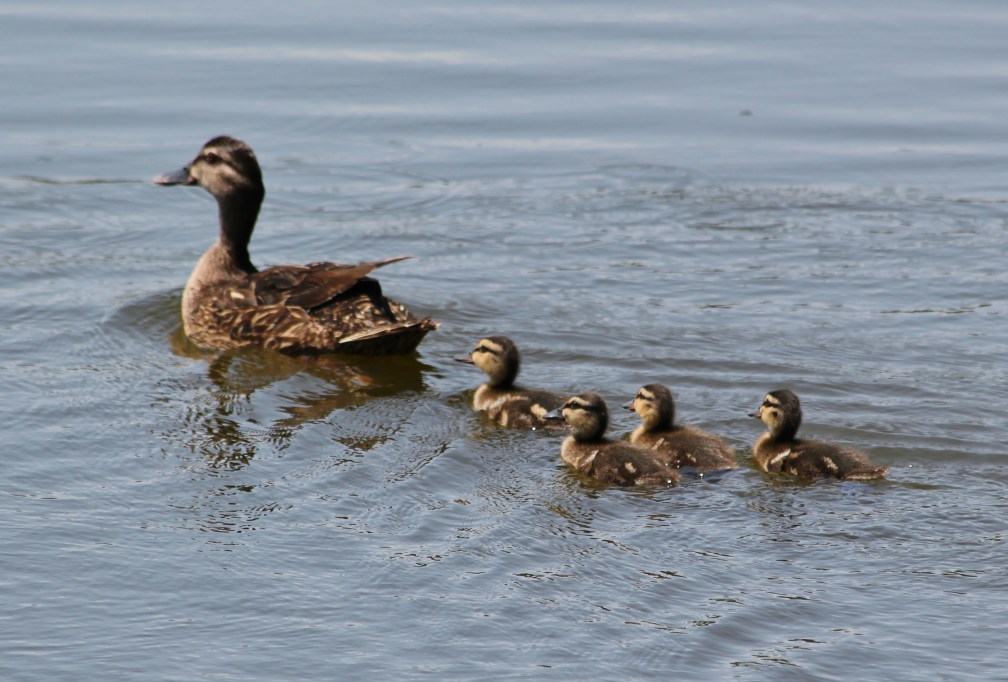
Ducks are about as common as squirrels. But they are so damned photogenic…
Squirrel meets the morning

Woodpeckers have drilled scores of holes in an old pine near my home. Most of the time the holes are occupied by European starlings, but on this day I noticed a squirrel had moved in.
Blog and newsletter writing: Nature park opening
One thing I’ve always loved about journalism is that no matter where you are or what you are doing, there is probably a story close by that is worth telling, and a picture worth shooting. I wrote this story about a nature park opening (and took the picture of the duck, too) for St. Petersburg College. This could have been a routine story of little consequence, but I think it turned out better than that.
By ARTHUR FREDERICK
SEMINOLE, Fla. — In a small corner of Seminole, in the middle of Florida’s most heavily developed county, a tract of nearly-forgotten land plays host to a wide variety of Florida plants and animals.
The land, only about 40 acres in all, is owned by (St. Petersburg College). It is the undeveloped half of a tract that the college acquired in 1969; the other half is home to the Seminole campus.
For years, the college has had ambitions to turn the land into a nature park, where students could observe the environment first-hand, and where Seminole residents could enjoy nature. Those ambitions became reality this year, when non-native plants (28 species in all) were removed from the site and construction began on a boardwalk, a 50-seat teaching pavilion and a floating dock (for use in water sampling) on the largest pond on the property.
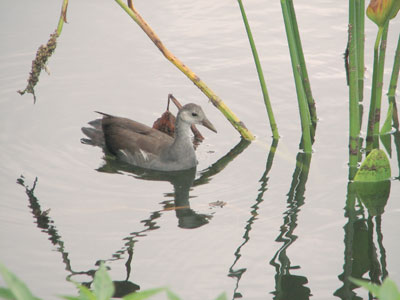 The nature park opens Tuesday. College officials knew there was plenty of wildlife on the site, which includes several ponds and wetlands as well as all sorts of plant life. But few people realized just how many species lived together in such close proximity on that small, suburban area.
“We knew that site was a true asset to both the college and the community,” said Jim Olliver, Seminole’s provost. “But I don’t think anyone really knew just how alive that 40 acres was.”
One person who was not surprised was Seminole resident Judy Fisher, an environmentalist who has spent many hours at the site, identifying plant and animal species of all types. Fisher’s research found rabbits, otters, opossums, raccoons, armadillos, coyotes and feral pigs; nearly 200 bird species; 24 species of dragonflies; 24 species of frogs, turtles, snakes and alligators; and seven species of butterflies.
Common plants include slash pines, wax myrtle shrubs and sweetgum trees. Some others include sand live oak trees, red bay trees, grape vines and giant leather ferns.
The recently completed boardwalk, nearly 200 yards long, offers a number of stations, which give visitors the opportunity to observe the site’s plants and animals. On one recent visit, a curious otter bounded up the boardwalk’s entryway and stopped to observe a human visitor before running off to a nearby pond.
The park and pavilion will support various SPC curricula (mostly in the sciences and especially for the Environmental Science Technology, and Parks and Leisure Services programs), and will offer recreation opportunities for the community. The Natural Habitat and Environmental Center will be open Monday through Friday from dawn to dusk; Saturday, 9 a.m. to 5 p.m.; and Sunday, noon to 5 p.m.
Writing for the business pages
It was never my intention to become a business writer, but that is what happened on more than one occasion. I spent a couple of years writing business stories for the Tampa Bay Business Journal, and I wrote about business frequently for United Press International. Also, I’ve done quite a bit of business writing for my public relations clients. This particular story was written for the St. Petersburg TIMES.
-0-
By ARTHUR FREDERICK
LARGO, Fla. — The parking lot surrounding the sprawling Hercules Defense Electronic Systems building tells the story. Built to accommodate 1,400 employee vehicles, it had fewer than 200 on a recent workday morning.
In the mid-1980s, Hercules enjoyed solid profits by selling smart weapons, missile warning and electronic warfare systems and other sophisticated electronics to the military. It employed more than 1,200 people. But the end of the Cold War has brought smaller defense appropriations from Congress. Contractors like Hercules are chasing fewer orders from the Pentagon.
A few weeks ago, parent company Hercules Inc., a Delaware-based chemical maker, announced plans to sell the subsidiary to Alliant Techsystems of Hopkins, Minn., a sale that is expected to be completed early this year.
The future of the subsidiary is unclear. But the company’s success will depend on its ability to adapt to smaller defense budgets and tough international competition.
Hercules Defense Electronic Systems came to Pinellas County in 1957, about the same time as three other large defense contractors – Honeywell, Electronic Communications Inc. and General Electric. It was known as Sperry Microwave and Support Systems Division until 1986, when it was acquired from Unisys Corp. by Hercules Inc., which wanted to expand into military electronics.
At the time of the sale, managers seemed cautiously optimistic about the defense industry’s future.
“Electronics is one of the few defense sector areas that has been identified for growth for the rest of this decade,” Hercules vice president and general manager James J. Thompson said just a few months after the 1986 acquisition, at a time when Hercules still employed nearly 1,000 workers.
Hercules’ work force has dwindled steadily since then. Just before Christmas, the number was 215. Hercules workers who remain are wondering if the purchase will mean another round of layoffs.
Management is saying little, but a company spokesperson, Berna Anspaugh, acknowledged that a review of current staffing levels is connected to the upcoming sale.
“It is not coincidental that (the staffing review) coincides with takeover time,” Anspaugh said.
The transaction demonstrates how defense contractors here and around the country are scrambling to merge, downsize, reposition and find new markets.
“This is the strategic acquisition we have been seeking as the industry consolidates,” Toby G. Carson, Alliant’s president and chief executive officer, said when the sale was announced in late October.
Not everyone is so optimistic. Defense has become something of a dirty word among economic planners and the growing legions of laid-off workers who can’t find work.
It wasn’t too many years ago that William Castoro, executive director of the Pinellas County Industry Council, would have done nearly anything to attract a company like Hercules. For years, defense contractors and their fat payrolls, well-paid engineers and subcontract suppliers were a key component of the Pinellas economy.
Kit Carson’s bench
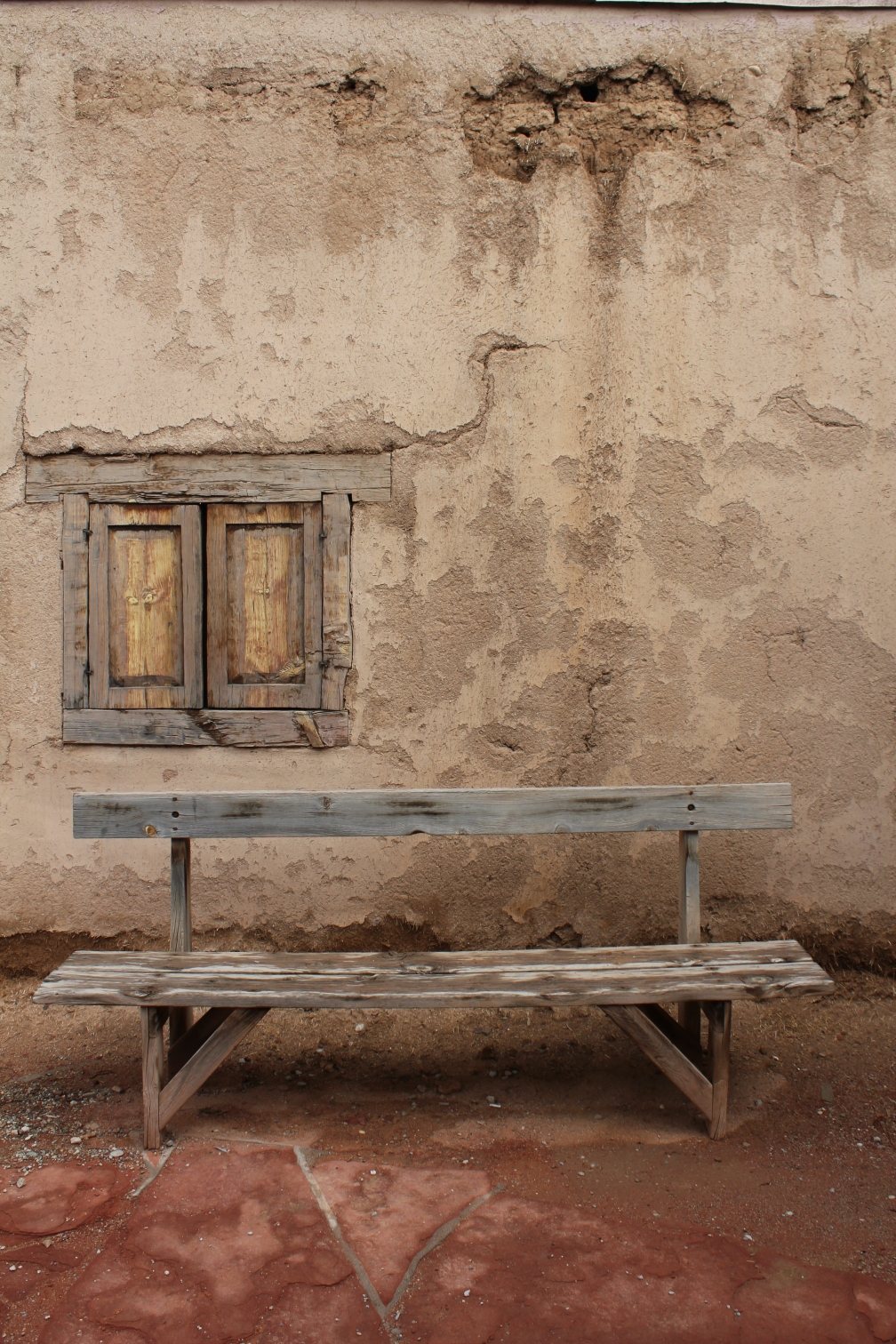
Kit Carson’s home in Taos, N.M. has been turned into a sort of museum. The house centers around a courtyard, which contains an outdoor kitchen. This wall and bench are a part of that courtyard. I liked the age of the wall and bench, and the earthy colors. It’s hard to take bad pictures in Taos. This was a stop on a motorcycle trip from Florida to New Mexico in 2012.
 Bill Frederick's portfolio