Horizoners: UPI’s series of feature stories

Back in the 70s and 80s, UPI offered a regular diet of feature stories to its newspaper clients. Since I worked in New England, my weekly 500-word feature was distributed along with the work of people in the other five New England states in a package called New England Horizons. Maine was rich in feature story opportunities, so this chore was usually fairly simple to accomplish, and the lighthearted nature of these stories was a welcome break from the usual grind of stories about state government and politics. Lakewood, a nationally-known summer theater, was usually good for at least one feature story per year.


Lakewood tent in 75th season

 By ARTHUR FREDERICK

SKOWHEGAN, Maine (UPI) – The play first produced at Lakewood in 1901 comes back this year as the oldest continuously operating summer theater in the nation celebrates its 75th anniversary.

Lakewood began in a roller skating rink at the end of a trolley line at the very start of this century.  And it hasn’t missed a season since “the Secretary” was first produced way back then.

For Joe and Katy Denis, who have been operating the theater the past three summers, finding a script for the “The Secretary” was a difficult task.

Image

Lakewood

“In 1973 the artistic director for the American Theater Co. in New York, Richard Kuss, suggested that we try and find the script,” Mrs. Denis said. “The former owners had seen a script for the play and said they didn’t think it was playable. But we said we would consider it if Kuss could kind a script.”

Kuss searched for a year and a half, and finally found the original script in a library in Philadelphia.

“The script was sent here, we read it and thought it was great,” Mrs. Denis said. “It ran for six weeks in New York, I went down to see it and the audience received it like a newborn babe.”

Beside “The Secretary,” Lakewood also will present “Life with Father,” which premiered at Lakewood in 1937. In addition, Patty Duke and her husband John Astin, Betsy Palmer, and Imogene Coca will appear this summer in such productions as “In Praise of Love”, “My Fat Friend,” “Irene,” and “Kiss Me Kate.”

The last production of the season will be a new one, “Winter Chicken.”

“We’re sort of starting the season with the very oldest and ending it with the newest,” Mrs. Denis said.

Continue reading

Feature writing: “Hey, kids! What time is it?”

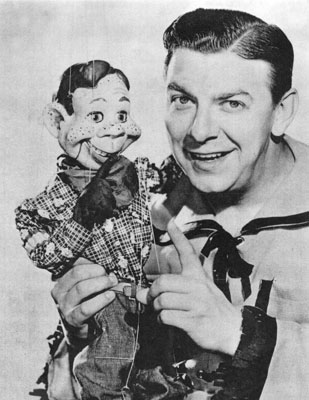
I bet you didn’t know Howdy Doody was from Maine, did you? Well, that’s almost true; actually, Buffalo Bob Smith retired to Maine when he was still in his 40s after the hugely popular Howdy Doody television show went off the air in 1960. I interviewed the very affable Buffalo Bob in 1986, and the resulting story was played in newspapers all over the country.


By ARTHUR FREDERICK 

GRAND LAKE STREAM, Maine (UPI) — Hey, kids! What time is it?

For Buffalo Bob Smith, Howdy Doody`s real-life buddy during the pioneer days of television, it may finally be time for retirement.

The old Howdy Doody show, the first children`s show on network television, went off the air in 1960, after more than a decade of entertaining millions of fledgling baby-boomers glued to their flickering black-and-white screens.

When that happened, Smith and his family moved to their log cottage on Maine`s remote Big Lake. Smith, who began in radio in Buffalo, N.Y., at age 15, bought three radio stations in northern Maine, and the family also purchased a winter home in Florida.

“I never really retired,” said Smith, who was only 43 when Howdy Doody left the air.

Now the 68-year-old Smith has sold the radio stations and is winding down. He spends most summer days fishing in Maine and much of the winter playing golf in Florida.

But the white-haired Buffalo Bob hasn`t forgotten the freckled, cowboy-booted marionette that made him one of the most famous television entertainers of the 1950s.

Howdy`s memory is still bright for Buffalo Bob, who keeps an original Howdy puppet in a glass case on top of a filing cabinet at his Florida home. Another original Howdy shares space at the Smithsonian in Washington with two other well-known puppets, Charlie McCarthy and Kermit the Frog.

Image

Buffalo Bob and Howdy Doody

“Next year is my 40th anniversary with Howdy, and we’re planning a 90-minute special,” Smith said. “We’re going to have a Peanut Gallery full of people who would have been kids back then, people like Johnny Bench and Barbra Streisand.”

Smith thinks the Howdy Doody shows still stack up well against modern children’s programming, which is often little more than animated cartoons.

“Howdy was a show that was not educational per se, although we did try to educate with songs that had themes like ‘Be kind to animals’ or ‘Cross the street with your eyes, not just your feet,’” Smith said. “Howdy was mostly slapstick and fantasy because kids like slapstick and being in on the joke.”

There was plenty of slapstick humor, and Buffalo Bob was often the butt of the joke. When Clarabelle the Clown uncorked his seltzer bottle or someone threw a pie, it was usually aimed at Buffalo Bob’s smiling face, much to the delight of the kids in the studio Peanut Gallery.

Television production costs have skyrocketed so much, Smith said, that it would be next to impossible to duplicate the Howdy show now.

‘You just couldn`t afford to do Howdy today because it appeals to such a limited audience,’ Smith said. “Unless you have Ford or General Motors making big grants for something like Sesame Street, you just aren`t going to get much more than cartoons, something you can put together for $200,000 and which will get played maybe 200 times.”

Continue reading

Feature writing: Small community in Maine boasts unique film society

Another feature story in the UPI/wire service style. Maine was an absolute treasure trove of offbeat stories…

By ARTHUR FREDERICK

MOUNT VERNON, Maine (UPI) – The Strange Fellows Film Society, consisting of two seventh graders and a 31-year-old scrap metal worker, hangs up a makeshift screen every other Friday and brings the likes of Marlon Brando and W.C. Fields to the Mount Vernon Schoolhouse.

The film society was born around Christmastime, when the scrap metal worker, Joe McLaren, decided that good movies would be way to beat the winter doldrums in Mount Vernon, which consists of a general store, a small hardware store and about 400 people.

“Besides, there have only been about four movies worth seeing around here this year,” McLaren said. There are movie theaters in Augusta, Farmington and Waterville, but all are about 20 miles away.

Mount Vernon offered a unique facility for movies, as well, a fine old Odd Fellows Hall, complete with ticket window. McLaren made tentative arrangements to rent the hall, and then went to see about securing the films.

“We had some trouble,” McLaren said. “We found we could get the films if we were a film society and didn’t make a profit. That was okay with us, and now we accept donations, enough to cover the cost of the films. Actually, so far, I’ve lost money every week.”

The worst part after McLaren got the films: the Odd Fellows decided not to rent the hall because of insurance restrictions.

“It would have been great at the hall,” McLaren said. “But this really hasn’t worked out bad. Mr. Gordon, the principal, has been helpful and so has everyone else.”

McLaren’s partners are John Jones, 12, and Mark Kelley, 13, students at Mount Vernon School. Mark’s sister, Dale, made the movie screen out of artist’s canvas, and both Mark and John help McLaren set up the screen and projector.

The first movie was “Requiem for a Heavyweight” with Anthony Quinn, and the showing was something less than a raving success.

“It was a real cold night and the school had shut off the heat,” McLaren said. “We had about 50 people here and it was about 45 degrees in the room. A lot of people left early.”

So far, the Strange Fellows Film Society has managed to solve its problems and bring good films to Mount Vernon. McLaren feels that if the venture succeeds through the winter, The going will be easier in summertime when the summer residents come back to town.

“We’re having ‘One-Eyed Jacks’ with Marlon Brando next Friday,” he said. “If you come, you better bring your overcoat.”

Writing for the opinion pages

I’ve written a lot of op-ed pieces over the years for a variety of clients. For those of you scratching your heads over the term “op-ed,” it means “opposite editorial” — it’s the page in a newspaper that is opposite the paper’s editorial page. Op-ed pages usually contain opinion pieces that may come from a variety of sources, and may or may not agree with the newspaper’s editorial positions.This piece — about employers who may be considering hiring older workers — was written for an employment attorney.


In an economy still recovering from the worst downturn in more than 75 years, why are employers even thinking about hiring older workers?

Aren’t older people hopelessly behind the 8-ball when it comes to technology? And isn’t that especially true if someone has been retired for several years?

Well, yes. And no.

Older workers may not be able to navigate the internet with their eyes closed, but they do have abilities and skills that younger workers not only don’t have, but may not even be able to recognize.

While many employers may love the technical abilities of younger people, they are less in love with their short attention spans; their lack of important life experiences; and, sometimes, their less-than-perfect work ethics. All that can make employers pine for the old days, and for older workers, too.

Some older workers who could hardly wait for retirement find it’s not all it was cracked up to be. Retirement can be boring after 40+ years of workplace challenges and excitement. As costs rise, that retirement nest egg may not go as far as they hoped. And there’s nothing like a job to inspire one to get out of bed in the morning.

If you are an older person who is contemplating a return to the workplace, here are some things to keep in mind:

  • BE READY FOR CHANGE: Technology moves at lightning speed, and you’ve got to to keep up. That doesn’t mean you have to turn yourself into an IT wizard; it just means there are technologies that apply to your field, and you must be able to work with them.
  • YOUR STATUS MAY BE DIFFERENT THIS TIME: Maybe you were an executive, department head or some other kind of boss before you retired. This time, employers may be more interested in your skills than in your management abilities. Make sure that’s okay with you before you take the plunge.
  • IF YOU ARE GOOD AT SOMETHING, SAY SO: Older workers may not be comfortable boosting themselves.  But if you don’t, who will?
  • FULL-TIME OR PART-TIME? Which would be better for you? Make sure you know the answer before you go back to work.

Okay. But what if you are an employer thinking about hiring an older worker, or workers? Make sure you navigate all the minefields before you take the plunge:

  • TREAT OLDER EMPLOYEES AS YOU TREAT ANYONE ELSE: Treating older workers differently is not only bad policy; it may also be illegal. Don’t act in a way that could be construed as discriminatory.
  • HIGHEST AND BEST USE OF EMPLOYEES: The older worker you hired to fill a lower or middle-level job may be capable of much more. Find out what those workers have done in the past, and what they are capable of. The person who has the most to contribute may be working for you in a lesser position.
  • YOUR OLDEST WORKERS MAY BE THE ONES WHO STAY: Research shows that the length of time a person stays in a job goes up correspondingly to the age at which they were first hired. In other words, younger workers may move on, while older workers may stick around.
  • TAKE ADVANTAGE OF THE INTANGIBLES: You may hire an older person because of his or her skills, but don’t overlook the fact that they may have much more to offer.  The many years of life experience they have can be extremely valuable; Older workers can effectively mentor their younger counterparts; And the work ethic that most older workers possess can be worth its weight in gold.


And… another business story

Advertising was one of my beats when I worked at the Tampa Bay Business Journal in the mid-1990s, and it was something that I really enjoyed. Advertising people are creative and interesting, and the work they do is often clever and attention-getting — at least, it’s SUPPOSED to be. Bill Lipphardt was a successful young guy on the Tampa ad scene and I wrote about him several times. Tragically, he died in 2000 at age 47 when his Porsche crashed during the holiday season.

-0-

Ad firm expanding as billings take off

Arthur Frederick
Staff Writer

When St. Petersburg-based Sun Jet dumped its New York ad agency and went shopping for a local replacement, it eyed the top of the list — WestWayne, the Bay Area’s biggest agency, and FKQ Advertising, another big gun.

That’s why more than a few eyebrows were raised last month when the three-year-old airline passed up those two agencies in favor of Lipphardt Advertising, a smaller shop whose 1995 gross billings were only around $9 million — a figure exceeded by about a dozen other local agencies.

There may be more eyebrow-raising in the coming months: Lipphardt expects to more than triple those 1995 billings next year and said they may go even higher than that.

Admittedly, a significant chunk of that increase will come from Sun Jet, the agency’s newest client, which will probably add around $10 million to Lipphardt’s top line. But other new business, plus additional revenue from existing clients, will also weigh in, and Lipphardt is busy gearing up.

Continue reading

Another one of those “people stories”

There is a lot of bad news in the newspapers and on TV, and that’s probably why people like good news so much. Readers and viewers tend to think the news media thrives on bad news, and that may be true to some extent, but the media are equally interested — maybe even more so — in stories that illustrate more positive examples of the human spirit. This story — about a young man who returned an old lady’s purse — is one of those. (By the way, the story doesn’t mention this, but this was a young black man and an elderly white lady. The photo that accompanied the story made this fact clear. This was a story angle that was not lost on the newspaper, the St. Petersburg TIMES).

By ARTHUR FREDERICK

It wasn’t the $28 in her wallet that Jacqueline Wendt thought of when she realized she had left her purse in a shopping cart at Albertson’s at the Largo Mall. She thought of the picture of her husband, Bill, who died last March.

“I never would have gotten that back because I don’t have the negative,” said Mrs. Wendt, 66, of Largo. “Money you can always get someplace. But you can’t replace those pictures, not when the people are gone.”

Mrs. Wendt needn’t have worried. Her purse, sitting in a shopping cart in Albertsons parking lot, was found by Thomas Carey, a 14-year-old who believes strongly you shouldn’t keep things that don’t belong to you.

“It wasn’t mine, and if it’s not mine I’m not going to take it,” said Thomas, a freshman honor student at Seminole High School. “My mom taught me that.”

Thomas was at the mall with his mother, Jeannette Carey, when he noticed Mrs. Wendt’s purse in the shopping cart. He fished it out and brought it to his mother’s car. Mother and son found Mrs. Wendt’s driver’s license and took a good look at the picture. Then Thomas went into the store to search while his mother stayed in the car with the purse.

Meanwhile, Mrs. Wendt was a few miles away at Island in the Sun Mobile Home Park, unloading her groceries.

“I went home and went to take my groceries out of the car,” she said. “That’s when I noticed my purse wasn’t there.”

Mrs. Wendt raced back to the shopping center. Her shopping cart was still where she had left it, but the purse was gone.

“I parked and went into the store and asked if they had seen my purse and they said no,” Mrs. Wendt said. “I went back out and a lady in the parking lot called me over. I thought she was having trouble with her car, but she reached in the window and pulled out my purse. We hugged and kissed and cried. She said she wished I could meet her son, and I told her I’d just wait right there for him.”

Meanwhile, Thomas was searching Albertsons for the woman in the driver’s license picture. When he walked out, Thomas got caught up in an emotional scene he hadn’t expected.

“I hugged and kissed him,” Mrs. Wendt said.

“I felt pretty good,” Thomas said.

Thomas Petit, assistant principal at Seminole High School, said a three-year-old program at the school tries to encourage students to return lost items they find.

“When kids find something, they turn it in, and we call them Good Deed Students and we announce it over the intercom,” Petit said. “The kids really feel good about it and we get a lot of things returned. We’ve had as much as $100 in cash, jackets, hats, notebooks – just about anything a kid would lose.”

Thomas will be a Seminole High School Good Deed Student today for returning Mrs. Wendt’s purse.

Jacqueline Wendt understood why everyone was making a fuss over Thomas, even if he didn’t.

“He hardly said anything, just `Oh, it was nothing,’ things like that,” she said. “But I think it was just great.”