
Tag Archives: Arthur Frederick
Writing for the real estate blog
I’ve been posting a lot of old UPI news stories, so let’s change the pace a bit. This story was written for my wife’s real estate blog, pinellasnewsboy.com . Stories and pictures on this blog are meant to describe what it’s like to live in Dunedin, FL, and that involves stories about unusual discoveries and people — yep, not unlike the old “people” stories written for United Press International or for the newspapers I worked for. In this case, I used to walk my dog along a golf course in Dunedin. One day, I noticed a small tree with a granite plaque at its base. The inscription led me to do a little internet research, and this story resulted. As I always do with her blog, I write the stories under her name.
There are two golf courses in Dunedin, and we live in a condo right between them.
Step out our front door and walk to the left, and in a minute or so you are in front of Dunedin Country Club. Walk to the right, and in about the same amount of time you are walking past a par-three public course, Dunedin Stirling Links.
 I usually walk east, in the Dunedin Country Club direction, when I walk Bo, our puggle. My husband usually goes in the other direction, and heads past Dunedin Stirling Links when it is his turn to walk the dog.
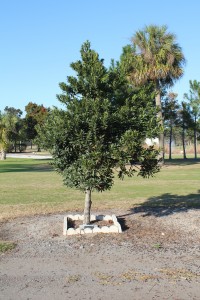
Down in that westerly direction, not quite as far as Alt. 19, there is a small tree. Its trunk is surrounded by white decorative blocks. We both have walked by that tree many times, but it was only recently that we noticed there was a small plaque in the ground at the tree’s base.
As you travel around North Pinellas County, there are quite a few commemorative plaques, but you have to pay attention or they simply blend into the background and you never see them. All of them have been put in place for a reason, but they don’t always have room to tell the entire story.
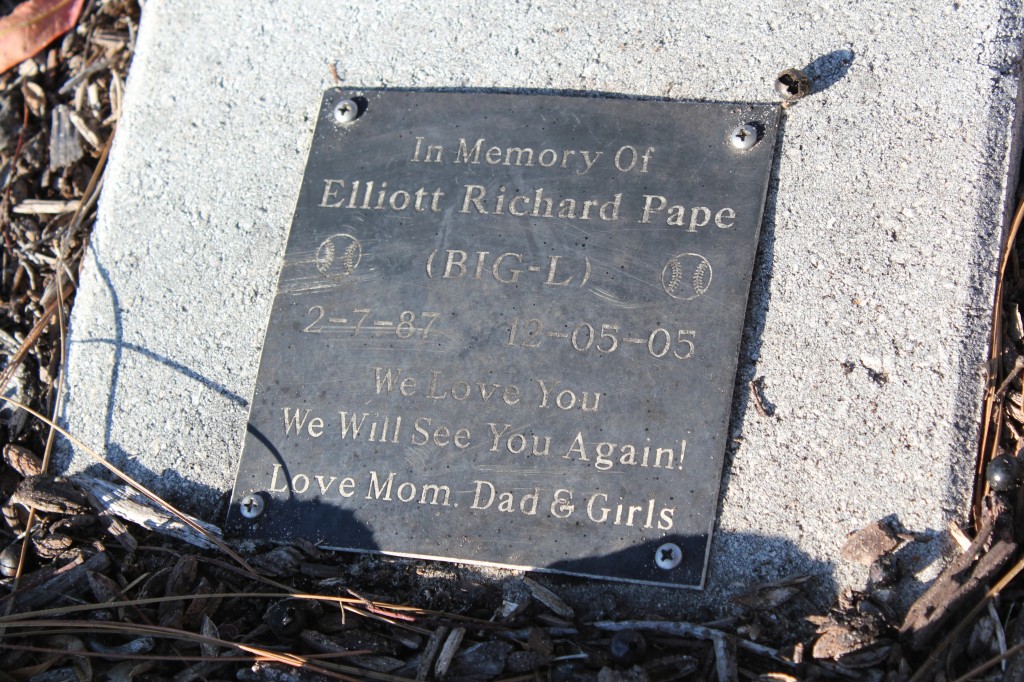
In this case, there isn’t much more than a name, a couple of baseballs, and a family’s loving sentiment. Here is what it says:
In memory of
Elliott Richard Pape
Big L
2 – 7 – 87 12 – 5 – 05
We love you
We will see you again
Love Mom Dad and girls
Someone went to some trouble to plant that tree in a young man’s memory, and I thought I’d see if I could find out more of the story.
It didn’t take much work. I went to the St. Petersburg TIMES website (okay, I know, its been called the Tampa Bay TIMES since New Year’s Day, but I don’t think I’ll ever get used to calling it that), and found a story published just before Christmas of 2005.
 Elliott Richard Pape was an 18-year-old Dunedin youth who worked part-time as a bat boy for the Tampa Bay Rays baseball team. On Dec. 12, 2005, he was killed in a motorcycle accident as he rode home.
Here is what the newspaper said about his death:
“On Monday afternoon, Pape was riding his 2006 Suzuki motorcycle home to Dunedin. He took the Roosevelt Boulevard exit ramp off Interstate 275 at 4:08 p.m. when he lost control in the turn, the Florida Highway Patrol said.
“He hit the brakes, but the motorcycle skidded into the guardrail, throwing him over the rail and onto the embankment, troopers said.”
So that’s the story of the tree. I don’t know whether Elliott Richard Pape liked to play golf at Dunedin Stirling Links, but hopefully his tree will grow and prosper, and golfers will stop there once in a while to read the plaque that his family put there.
Politics and divorce
I had forgotten about this story, but I found it deep in my clips file. I remember being assigned this story and not really wanting to do it. I didn’t like the idea of calling up these politicians and asking them to talk about their divorces. Sure enough, none of them wanted to talk. I do remember that this story got pretty good play around the country — this clip came from the Tampa Tribune.
Divorce no bar in Maine politics
By ARTHUR FREDERICK
AUGUSTA, Maine (UPI) — Top-level politics is no family matter in Maine, where the state’s two U.S. senators recently filed for divorce and the last two governors are among the ranks of the formerly married.
At a time when the public has focused on Gary Hart’s marital situation, the old adage that one must be stably married to succeed in politics has been thrown out the window in the Pine Tree State.
Gov. John McKernan has been divorced since 1978. Democratic Rep. Joseph Brennan, who swapped jobs in January with former GOP congressman McKernan, was divorced in 1976. And when GOP Sen. William S. Cohen and Democratic Sen. George Mitchell announced within the past six months they were seeking divorces after marriages of 25 and 28 years, respectively, it raised more eyebrows in Washington than in Bangor or Portland.
Rep. Olympia Snowe, R-Maine, the state’s other member of Congress, has been a widow since 1973. She and McKernan are good friends and say they have dated.
“The people in Maine think nothing of it,” said James Russell Wiggins, former editor of the Washington Post, who moved to coastal Maine in 1969 to publish the weekly Ellsworth American newspaper. “I don’t think anybody ever raised divorce as an issue with Brennan’s election or McKernan’s, and you don’t hear about it with Cohen or Mitchell, either.”
Some political analysts say the state may have so many divorced politicians because Maine voters stress Yankee independence over conventional morals.
Another people story from Maine
Stories about unusual characters doing unusual things in backwoods Maine was a formula that got stories into newspapers across the country.
Psychologist is happier as a boat builder
By ARTHUR FREDERICK
GEORGETOWN, Maine (UPI) – Sam Francis respects things made of wood.
He carved his boatyard out of the wood from the banks of the Back River, and he works on boats crafted from wood.
Francis restores pleasure vessels, many of them built in the first half of this century and each one becoming rarer with the passing years.
The work is primarily a hobby that provides a few dollars, and Francis wants to keep it that way.
“The boatyard doesn’t really have a name,” Francis said. “We’ve been calling it the Back River Boat Works, but sometimes it gets called the Back Yard Boat Works.”
Francis, 32, came to Maine three years ago via Massachusetts and Connecticut. He was trained as a psychologist. He was a psychologist in the service and a housebuilder in Massachusetts before coming north.
“It really started as a hobby,” he said. “My wife and I have been interested in boats for a long time, and I’ve done repair work here and there.
“At one point we bought a 40-foot ketch. It needed a lot of work and we re-built it. It needed sails and we learned sail making. We had to learn how to because we couldn’t afford to have someone else do it.”
That boat gave way to a 60-foot schooner, and Francis did the same with her.
“We sailed as much as we could, and I became sort of an itinerant boat worker,” he said. “We just sort of backed into it.”
The move to Maine first involved plans for self-sufficiency. But scratching a living from the earth in northern New England isn’t easy, with its long winters and short growing season.
“We originally came with an interest in homesteading,” he said. “We do grow most of our own food, and we have a greenhouse, we heat with wood, and we’re semi self-sufficient.”
“The boat works provides the cash flow. We’re doing alright, but from a purely business standpoint it’s hard to say. If we make money, we put it back into the shop.”
“I try to stay away from the hard business aspects of it. Mostly I don’t look at it as a business at all.”
Sitting in the yard now is a beautiful 67-foot yacht named “Hutoka.” Francis said she was built in 1904 and won the Bermuda race in the 1920s. The present owner, a Bath family, is having the boat completely re-fitted.
“When we’re done, possibly in the spring, we’ll have just about rebuilt her.”
Journalism as history
Stories like this were always hard for me to resist — some bit of offbeat or unexpected history discovered in our backyard. Perhaps something dug out of the ground, or tidbits discovered in some museum archive. In this case, it was an expert trying to interpret something that had been found on the ocean floor. Phoenicians off the coast of Maine in 500 BC? Well, it COULD have happened. And if someone with credentials said it was possible, it was worth writing about. This Maine story got in papers around the country, including the Boston Sunday GLOBE.
Ancient jugs found off Maine coast
By ARTHUR FREDERICK
CASTINE, Maine (UPI) – The two jugs are white, or off-white, and had rested on the ocean floor not far from Castine for many years before a diver found them a few years ago.
How long did they lie submerged? Scientists have theories that run from around the time of the American Revolution back to hundreds of years before Christ.
Warships weren’t uncommon in Maine waters during the Revolution 200 years ago. Several American ships were scuttled not far from where the jugs were found. They could have been thrown overboard by a sailor. Or, they could have been moved by currents from the nearby wreckage of the sunken ships.
But Dr. Barry Fell has another theory.
Fell is head of the Department of Comparative Zoology at Harvard University, and a master of ancient languages. He believes the jugs could have come from Phoenician sailing vessels, which he thinks may have visited the coast of Maine centuries before Christ lived.
In a recent book, Fell contends that parts of North America were settled by Celts from Portugal perhaps 500 years before Christ. He based his theory on the discovery of inscriptions found in dank stone caves that dot portions of New England.
The inscriptions, he said, are Ogam, a form of writing invented by Phoenicians and adopted by Celts from Iberia and North Africa.
“I first heard about it (the jugs) when two members of the Maine Archeological Society told me divers had found amphoras, which were containers used for oil and wine,” Fell said.
Fell was most excited to learn the containers were found near where he had predicted Phoenician artifacts might be discovered.
Fell had interpreted rock carvings on nearby Monhegan Island to read “Long ships of Phoenicia; cargo lots landing-quay.” He said the inscriptions could mean Phoenician sailors had traded along the coast hundreds of years ago.
Besides the containers and the Monhegan Island rock inscriptions, there are other possible signs that Phoenicians came to the region.
It has been rumored for several months that the remains of several ancient ships were found off the cast near Kittery by divers searching for the wreckage of Revolutionary War ships. John Hallett, director of the Kittery Museum, confirmed wreckage had been found, but declined to pinpoint the location.
Fell said Hallett “visited me, and asked if I had ideas that Phoenicians may have visited North America because his divers had seen what seemed to be hulls of ancient ship son the ocean floor.”
“What we have,” fell said, is this very tantalizing report, and we don’t know whether it’s true or not.”
Political writing: Shadowing the candidates II
It was standard practice to cover top-of-the-ticket political campaigns in part by spending some time on the campaign trail with the candidate. In 1976 in Maine, the U.S. Senate race was between incumbent Senator Edmund S. Muskie and Republican challenger Robert A.G. Monks. I spent a day with each of the candidates and turned out these stories. Looking back, I’m not sure how much such stories added to the quality of the campaigns. But it was Standard Operating Procedure, so that’s what we did.
EDITOR’S NOTE: Robert A.G. Monks thinks he can beat Sen, Edmund S. Muskie, D-Maine, this November because of voters’ disenchantment with the Washington establishment. UPI recently spent a day with both Monks and Muskie. Monks campaign style is examined in this, the second part of two parts.
Monks campaigns shaking hands in many places
By ARTHUR FREDERICK
FREEPORT, Maine (UPI) – Robert A.G. Monks started his day as he has started many others during his campaign against Sen. Edmund S. Muskie; he shook hands with people at their place of employment.
This time it was at L.L. Bean’s in Freeport. The handshaking took up most of the morning, and he stopped off at a lunch program for the elderly and at the local police and fire stations before he took a rare lunch break to talk about his campaign.
Monks is getting around in the same wine-red International Scout he used during the primary, and he’s still usually accompanied by John Miller, who was a graduate student at the University of Maine at Orono before getting involved in Monks’ campaign last April.
The Scout looks the same except for an antenna sprouting from the roof.
“It’s a telephone,” Miller said. “We just put it in. It’s the only way we can keep in touch with the office.”
Monks’ campaign style has some definite patterns. He likes mill gates, country stores, programs for the elderly and fire stations. He claims to have campaigned at more than 70 mill gates and more than 40 programs for the elderly, and he usually stops to talk to the firemen whenever he can.
There was only one fireman on duty at the Freeport Fire Station when Monks arrived, a man perhaps a little taller than Monks, who is six-foot-six-inches.
“You,” Monks told the man, “may be the first person I’ve met during the campaign I can look in the eye.”
Political writing: Shadowing the candidates l
Part of our campaign coverage, at least in top-of-the-ticket campaigns, was to spend a day with each candidate and then report on campaign styles. Looking back, I’m not sure this contributed much of value to the election process – there was no discussion of issues, for example. It was really a look at style rather than substance. Still, it’s what we did, and I remember these days spent with the candidates as fun and a good excuse to get a day away from the office grind. This story was one that I wrote about Ed Muskie; the next one looks at his Republican challenger, Robert A.G. Monks.
EDITOR’S NOTE: The elections are less than two months away. Sen. Edmund S. Muskie and his Republican opponent, Robert Monks, are campaigning hard. UPI spent a day with each of the candidates, and their campaign styles are examined in this, the first of a two-part series.
By ARTHUR FREDERICK
BANGOR, Maine (UPI) — Sen. Edmund S. Muskie, D-Maine, and his Republican opponent, Robert A.G. Monks, have little in common except their neckties.
Like most Maine politicians, Muskie and Monks share an affection for the Maine necktie, something which has become essential to a political campaign.
Sen. William D. Hathaway, D-Maine, is generally credited with starting the necktie binge. He owns no fewer than 12 lobster ties, including a specially-made bow tie.
Hathaway wore a pine-tree-and-potato to the Democratic National Convention in tribute to Jimmy Carter. He said the potatoes looked a great deal like peanuts.
Muskie began a day of campaigning in the Bangor area last week with a news conference at a local television studio. He wore a blue tie speckled with little white lobsters. Monks campaigned early this week in Freeport, first touring the L.L. Bean Co. facilities. Monks’ tie was also blue, and it sported little miniature outlines of the state Maine.
Muskie is 62 and the son of a tailor. He has been in public life ling enough to develop what supporters call dignity and what his detractors see as stuffiness.
Monks is 20 years younger, and lived in Massachusetts until a few years ago. He is wealthy, wealthy enough to list his occupation as “fiduciary.”
Muskie approaches people confidently, and speaks off the cuff. Monks often says the same thing: “I’d like to introduce myself. I’m Bob Monks. I’m running for the United States Senate, and I wanted to pay my respects.”
Muskie’s recent morning began with a news conference at a Bangor television station. Then he went to the local GTE Sylvania plant and shook hands with the workers. He spent more time there than he thought he would.
“There’s people working there from as far away as Millinocket,” Muskie said as he walked form the plant to the car. “I don’t think I met two people from the same town, and that’s why I stayed there so long. They all go back home at night and talk to their friends.”
Mount Vernon, Maine

Wheels Through Time Museum
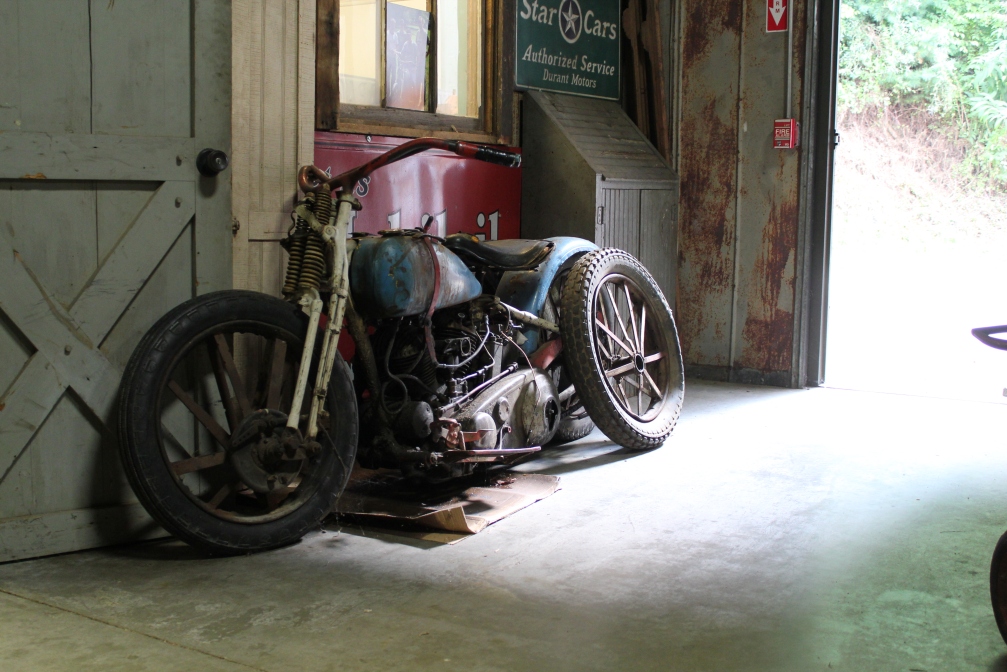
Maggie Valley, N.C.
Economic development writing: The story of Eastport, Maine
There are a couple of things about this story that are worth mentioning: First of all, it was always exciting to get one of my Maine stories published in a big-city newspaper somewhere. Getting one of those stories into a Boston newspaper was good, but getting something printed in a big paper in some more distant locale was cool indeed. This story was carried by the New York Daily News, and that didn’t happen every day. Second, it’s a story about Eastport, Maine, just about the most distant and remote community in the entire state. Go north along the U.S. coast, and just about the last U.S. town you will pass near is Eastport (okay, okay, to be perfectly accurate, the actual border crossing is in Calais, a few miles away). Back in the 70s, a large corporation (the Pittston Co.) decided it wanted to build an oil refinery there. Eastport had a deep-water harbor that could handle oil supertankers. The refinery never happened because of environmental concerns. I covered a number of hearings in Eastport about this refinery project, and it was a l-o-n-g drive from home.
By ARTHUR FREDERICK
EASTPORT, Maine (UPI) – This easternmost city in the nation and former sardine capital of the world is dying. The rotting piers and empty storefronts are conspicuous testimony to that.
But a new chapter in Eastport’s history is about to be written. A New York oil company wants to develop an oil refinery on Moose Island, just outside the downtown area.
Eastport has one huge, underdeveloped natural resource. That is a beautiful, sheltered harbor three by five miles wide and between 90 and 385 feet deep. The harbor, big enough to handle the biggest supertankers, is often called one of the three best deep-water harbors on the East Coast.
The Pittston Oil Co. of New York has announced plans for a $350 million, 650-acre refinery that would produce 250,000 barrels of heating oil and industrial fuel per day.
Some Eastport people are thrilled. Some are not.
 Bill Frederick's portfolio