Indian dig reveals much on life 7,000 years ago

Since I just posted a story dealing with Maine’s Indians, let’s keep the theme going with this story written in September of 1975. I found this clip in the Brownsville (Texas) HERALD.

By ARTHUR FREDERICK

ALTON, Maine (UPI) – The Indians camped next to the Pushaw Stream because the fishing was good. And they stayed for thousands of years.

A University of Maine anthropology professor, a group of associates and students spent the summer scraping away the dirt covering the campsite and learned a lot about the Indians who lived along the stream starting about 7,000 years ago.

Prof. Dave Sanger said the Indians who lived here were not the forebears of the Indian tribes who now live in Maine.

“In my opinion these people were not the ancestors of the modern Indians, such as the Penobscots,” he said.

Sanger said work at the campsite has shown that different groups lived in the area during the years.

“They came in at a time when the forests in Maine were changing their character. I think they were following the forest type they were accustomed to from the St. Lawrence Drainage area,” he said. “They stayed here until about 3,000 years ago and then all traces disappear and they seem to be replaced immediately with different tools and burial techniques.”

The Indians who lived along the Pushaw spent at least part of the year along the coast fishing and harvesting shellfish. But Sanger thinks it took them some years to learn to take advantage of the sea.

“It may be that some of the earlier people were not adapted to this coastal interim migration pattern,” he said. “I think we are getting evidence of some of the very earliest people who came into Maine not being tuned in to the marine resources. I have a suspicion that the first of these people may not have been fully aware of the potential of the Gulf of Maine.”

“These people made use of inland resources. There was good fishing. They also went to sea on occasion.”

Perhaps the best aspect of the dig site is that it has never been disturbed. Sanger said there used to be many potential dig sites in Maine, but most of them have been destroyed through construction or farming. Many of those left have been dug by amateurs. Sanger’s site is on private property and has never been dug before.

“It’s a big site and it contains several components, each representing different people at different times,” he said. “The first starts about 7,000 years ago and is right down on the glacial till. Then we come up to about 4,000 or 5,000 years ago, the so-called Red Paint people, and then 3,000 years ago we have the Susquehanna. That goes to 2,000 years ago and then we have a break.”

The site was found about five years ago and Sanger said work has been conducted slowly ever since. He estimated only about 15 percent of the site has been dug.

Maine Indians want some Baxter State Park land for reservation

During my working days in Maine, I enjoyed writing stories about the state’s Indian tribes – the Penobscots, the Passamaquoddys and the Micmacs. The big story about them (or at least the Penobscots and the Passamaquoddys – the Micmacs were excluded) was the Indian Land Claims Case. A sharp young lawyer in the 1970s found that a key treaty between the state of Maine and the Indians had never been signed by the state and, as a result, the two tribes had a legitimate claim to a huge portion of Maine’s land. The Indians had a great case and the state agreed to settle it (using federal funds – thanks, President Jimmy Carter), and the two Indian tribes suddenly became big players in Maine’s economy.

But there were other stories involving the Indians. In this particular story, the Wabanaki Confederation (made up of Passmaquoddys, Penobscots, Micmacs and Malaseets) wanted a new reservation that would include all the tribes, and they took a step in that direction by briefly occupying part of Baxter State Park. They didn’t get what they wanted, but they did draw some crucial attention to their cause.

I wish there was an Internet back in the mid-1970s. If there had been, I could have done a better job of researching this story. I would have learned that the Wabanaki Confederation was an organization that stretched back to the late 1770s, that it played a key role in the American Revolution, and that under the Treaty of Watertown signed in 1776, Wabanaki soldiers, even those from Canada, had the right to join the U.S. military, a right some have exercised as recently as the war in Afghanistan.

Not sure when this was written, probably around 1976.

 By ARTHUR FREDERICK

INDIAN ISLAND, Maine (UPI) – One of the Indians who had camped in Baxter State Park for nearly a week said Thursday his group hopes the state will provide land for a new Indian reservation.

The Indians were members of the Passamaquoddy, Penobscot, MicMac and Maliseet tribes, but all belong to the Wabanaki Confederacy.

wabanaki mapStanley Neptune, who had spent six days at the park with 27 other Indians, said the Wabanakis hope to leave their own reservations and start a new reservation. He said the Wabanakis feel the present tribes are losing their culture, and the new group hopes to preserve the Indian ways.

Neptune also said the Indians left the park because they had accomplished what they wanted, and not because of pressure from park and state officials.

“Everything that happened was good,” Neptune said.

Neptune said the Indians had gone to the park hoping that part of Baxter could be allotted to them. Mount Katahdin, located within the park, is considered a sacred place by the Indians.

“Our idea was to have a place to live,” Neptune said. “We want a place for the Wabanaki Confederacy.”

wabanakiflagcolorNeptune said lawyers are negotiating with the state to see if some land, perhaps some of the state’s public lands, could be set aside for the Wabanakis.

“It was our hope at first to get part of the park, but we found we couldn’t stay there,” Neptune said. “It was a place to go to get answers, and we got answers. We left because it was time to leave.”

Neptune said the state agreed to drop illegal entry charges against nine Indians who were arrested when they tried to join the original group. He also said that tribal governors, who had opposed the action at the park at first, seemed to be changing their minds, and said a meeting between the governors and those who took part in the encampment at Baxter was set for Friday.

“The governors were against us, but now they are changing their thinking.” Neptune said. “We’re trying to save our culture. Not too far in the future, there won’t be any more Indian people.”

Another Indian who had gone to Baxter, Sam Sapio, said the Wabanakis had taken part in some spiritual events at Baxter, but he declined to elaborate.

“We went up there to do some of our traditional things,” he said. “I can’t tell you about that.”

Mount Katahdin has been a spiritual place for Maine’s Indians for many years.

“When they had trouble in the tribes, they would go there to meditate,” Sapio said.

Gov. James B. Longley, who on Wednesday said the state would remove the Indians by force if necessary, said he was glad they had left on their own.

“It is a fine example of how reasonable people can accommodate what is right without needless conflict,” he said.

Jud Strunk uniquely remembered by his sons

Jud Strunk was a well-known folk singer and entertainer who lived in the western mountains of Maine — right in the middle of ski country. His career had a couple of highlights; he had a hit single called “Daisy a Day” that did well on the pop and country music charts, and he spent a season as a regular on the hot comedy show “Laugh-In.” But mostly he was a talented Maine guy who never really wanted to leave his native state. In 1981, at the age of 45, he died when he suffered a heart attack while flying his vintage airplane near Maine’s Carrabassett Valley Airport. I didn’t know him very well, but I do remember drinking with him and a group of people at a bar in Winthrop, Maine in the late 70s. This is a story about how Strunk’s sons memorialized him several years afte rhis death.

Cross-country trip, film evoke folk singer’s windswept ways 

By ARTHUR FREDERICK 

KINGFIELD, Maine (UPI) — Jud Strunk, a folk singer and a regular on the TV show “Laugh-In,” was best known around Maine’s ski country, where he played music and raised hell until a plane crash killed him in 1981.

jud strunk album picJust before his death, Strunk, 45, and his teenage son Joel loaded up a battered Volkswagen Thing and headed out on an 8,000-mile trip that took them to Colorado and Texas and a lot of places in between.

Twenty days after their return to Maine, Strunk’s World War II-vintage plane crashed in the woods near Carabassett Valley Airport in Maine’s western mountains.

Joel and his brothers, Rory and Jeff, wanted to find a suitable way to make note of their father’s life. After talking about the trip and about a poem Strunk had written entitled “Bury Me on the Wind,” they decided to re-trace the route in the same old orange Thing and scatter their father’s ashes along the way.

Jeff couldn’t make the trip, but Rory and Joel set out in the convertible, vowing to keep the top down throughout the journey because of their father’s love of the wind.

A videotape Rory made of the trip, entitled “Bury Me on the Wind,” premiered last month at a local ski resort tavern and has been gathering plaudits ever since. The video won second prize in a national contest sponsored by Sony, and also placed in the American Film Institute’s student video contest.

“After my dad passed away, we were listening to his music and we got the inspiration to retrace the trip,” Rory said. “He loved the wind, he loved flying, and we thought that scattering his ashes on the wind during the trip was a most appropriate way of saying goodbye.”

The original trip was part work, part play. Like many musicians, Strunk went on tour during the summer. During this tour, he and his son combined gigs with visits to places that had special significance to Strunk.

The memorial trip faithfully followed the route of the original tour, with the brothers scattering their father’s ashes at important spots along the way.

International Paper Co. breaks a union

The strike by union paper makers at the International Paper mill in Jay, Maine in 1987 was the toughest and strangest strike I ever covered. There had been a long history of fairly good relations between the company and the union, and IP profits were way up around that time, so it was difficult to understand why  the company took such a hard stand against the union, demanding wage and benefit give-backs and then locking out the union once they went on strike. Once the union members were locked out, the company  replaced them with non-union workers. In 1988, the strike ended and the union was gone.

By ARTHUR FREDERICK

JAY, Maine (UPI) – Union paper workers walked off their jobs at International Paper Co. Tuesday after refusing to accept a new contract offer which contained a number of concessions.

Several hundred members of Local 14, United Paperworkers International Union, immediately set up picket lines outside the mill gates. Others drove to Augusta where they were joined by union members from other Maine companies outside the Blaine House, the governor’s residence.

The crowds were orderly, and there were no injuries or arrests reported.

“Someone drove a skidder through fence at the mill late Monday, and took down 30 or 40 feet of fence, but today there really hasn’t been anything going on,” said Police Chief Erland Farrington.

International Paper Co. mill, Rumford Falls PIC

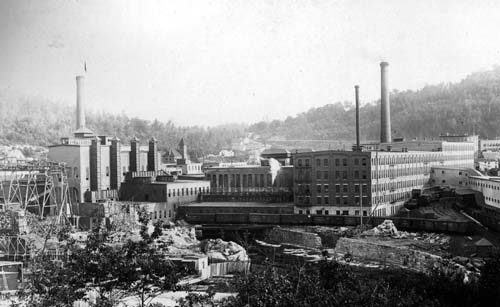
The International Paper mill in Jay, Maine in its early years, around 1910

The mill management had vowed to keep the mill open and operating, but all paper machines had to be shut down because of a number of incidents overnight at the plant. Mill officials said power was shut off during the night, and a number of machines in the mill were damaged.

Joseph Pietrosky, an IP spokesman, said the mill managed to get one paper machine operating by noon.  Other machines were still not operating, he said.

“Only one machine is running, and for most of the evening no machine was operating,” Pietrosky said. “A damper was closed in the plant, causing pressure to build up in the boilers, requiring that boilers be shut down. And we had a chlorine car tampered with during the night, causing liquid chlorine to escape into the air, a very serious situation.”

Pietrosky also said someone had used a sharp object to damage a paper machine wire.

“That will cost $80,000 to replace, and it will take more than eight hours to take it off the machine and replace it,” he said. “All told, we had a very disappointing evening, with a number of incidents that had the potentiality of creating unsafe conditions as well as interfering with normal operations.’

About 1,000 workers and supporters picketed outside the Blaine House, chanting slogans and cheering when passing drivers would blow their horns.  The demonstrators walked around the block in front of the Blaine House driveway, next to where Gov. John McKernan has been installing a new tennis court.

Later, the workers crammed into the State House Hall of Flags for a rally.

A delegation of workers met with McKernan, and other workers milled around in the halls, describing their positions to legislators.

In Washington, the UPIU announced it will switch to company-wide negotiations with International Paper, and use a publicity campaign against its demands.

“Unions must learn new ways to fight in this country,” said Paperworkers President Wayne Glenn, who said International Paper unfairly is seeking concessions at a time when it is prospering. “We’re going to attack on all fronts.”

The re-birth of Harley-Davidson

In 1988, the Harley-Davidson Motor Company loaned me a brand new red Harley Electra Glide and invited me along on a ride from Maine to Milwaukee to celebrate Harley’s 85th birthday. I wrote several stories about the ride and about the company’s resurgence from the road. I also had a blast! This story was one that I wrote once I returned to Maine. This clip was published in the Chicago Sun-Times, but the story was also published in papers around the country, as well as in Europe and Australia.

Harley roars back to lead the cycle pack

By ARTHUR FREDERICK

MILWAUKEE (UPI) – Harley –Davidson Motor Co., careening toward extinction just five years ago, has roared back to lead the pack, scooping up an increased market share from the best of the Japanese motorcycle builders while placing itself solidly in the black.

It was a different story in 1983, when Honda and other Japanese motorcycle makers pushed Harley, America’s only surviving motorcycle manufacturer, to the edge of bankruptcy.  But Harley searched its past and re-discovered a formula that seems to be redefining the company’s future.

The quality of the big V-twin engines Harleys had declined seriously over the years, and antiquated manufacturing techniques kept costs high and production low.

When Japanese builders such as Honda and Yamaha began building low-cost, high-tech super-heavyweight touring bikes, once the sole domain of Harley-Davidson, a number of former Harley riders jumped ship.

“We simply weren’t building a product that the customer wanted from a quality point of view, “ said Richard Teerlink, Harley’s president. “The customer needs quality, especially when he is paying a premium price for the product.”

Harley had once dominated the large-displacement motorcycle market, but by 1983 Harley’s market share for motorcycles of 851cc or more had faded to just 23.3 percent, while Honda’s share of the market had swelled to 44.3 percent. And there seemed to be no end to the downward trend.

“They used to call me Dr. Doom around here – my reports were always that the sky was falling,“ said Frank Cimermancic, Harley’s director of business planning.

With its back to the wall, Harley began fighting back.

The company claimed Honda and other Japanese manufacturers were dumping big-displacement motorcycles in the united States in order to harm Harley, and asked the Reagan administration for stiff tariffs on the biggest Japanese bikes,.  The administration responded with a five-year tariff plan.

With the tariff providing some breathing room, Harley went to work and began devising a strategy for getting back on solid ground. Harley’s strategy worked so well that by the end of 1987, its market share had zoomed to 40 percent, and was still climbing steadily.

1988 Harley-Davidson Electra Glide 85th Anniversary Edition

In the first quarter of 1988, Harley’s share climbed to 50 percent, while Honda slipped to 22 percent.

“We are really smoking,” Cimermancic said. “It is hard to believe, if you had told me five years ago we would be doing this kind of volume now, I would have asked you where you got your drugs from.”

Continue reading

Scott and Helen Nearing

In 1973, I moved from Boston to central Maine, having been transferred by UPI to cover, among other things, Maine government and politics. I settled in a small, rural Maine town, Mount Vernon, a village of around 300 people. I soon learned that Mount Vernon (and many other similar Maine villages) had become the home of young hippies from all over the country who were searching for a simpler, back-to-the-land lifestyle. At the time I was unaware that most of these young people were following the teachings of Scott and Helen Nearing, whose 1954 book, “Living the Good Life,” was a handbook for simple rural living.

A year later, in 1974, I wrote to Helen Nearing at the Nearings’ home on the coast of Maine, requesting an interview. She invited me over.

This story resulted from that interview.

One thing I remember about that visit, something that didn’t make it into the story: At one point I gave the 69-year-old Helen a ride down the road in my Chevy Nova, which had a bad clutch throwout bearing and made sort of a grinding/screeching noise. When I shifted the car into second, she cocked her head and said, “Hmmmm. Sounds like a bad throwout bearing.”

This story was carried in newspapers around the country, but I found the old clip in the Connellsville, Pa. DAILY COURIER.

Ex-professor, 90, remains highly active with writing

By ARTHUR FREDERICK

HARBORSIDE, Maine (UPI) – Scott Nearing is 90 and his face is creased with age and from many cold New England winters. His eyes disappear when he smiles.

Nearing and his wife Helen, 69, have homesteaded in New England for more than 40 years, ever since they decided to leave the city and search out a simple life. First in Vermont, and now in Maine, they have grown their own food organically, have built their own buildings out of stone, and have cut their own firewood.

Nearing turned his back on Western civilization years ago, after being fired from teaching jobs at two colleges because of his radical political beliefs. He thinks Western civilization has been on the decline since the late 1800s.

“Western civilization is on the carpet, just like Nixon is now,” he said.

ScottNearing pic

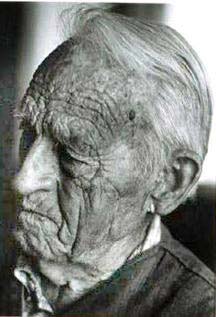
Scott Nearing

Nearing’s day began as usual at 4:30 a.m., and he worked on his latest book until breakfast.  He had spent the morning working around Forest Farm and now was eating homemade soup out of a wooden bowl.

“I’ve been working on this theme since 1926,” he said. “It’s called, ‘Where is Western Civilization Going?’ It’s a social analysis of civilization. Almost no one has analyzed society objectively as far as social organization is concerned. That’s what I’m trying to do.”

Nearing threw a faggot of twigs on the fire in the kitchen woodstove and went out to the woodshed, tugging a wheelbarrow full of saws and axes behind him. The Nearings burn driftwood and dead trees as much as possible, cutting down live trees only when they have to.

Helen led the way to a half-finished stone building at the foot of the hill, across the road from the bay. The building will be a library and garage and will stand in front of the Nearings’ new stone house, to be finished hopefully by next fall.

“I’ve done all the stonework,” Helen said. “If people stop by to help, they hand the stones up to me and I put them in place.”

Finding help hasn’t been hard. In recent years there has been a steady stream of visitors, mostly young people, who have read “Living the Good Life,” a book about homesteading which Scott and Helen wrote in 1954.

“Last year I kept a head count and we had 2,300 visitors,” Helen said. “This past year I stopped counting after 2,500.”

The Nearings have lived in an old frame farmhouse since they came to Maine 22 years ago, and they are looking forward to moving into the new stone house.

“This place isn’t our house,” Nearing said about the farmhouse. “It’s somebody else’s house.”

Helen ran through the snow to the house site and pointed out where the rooms would be.

“I’ll have a room in front, overlooking the water, and Scott’s room will be in the back with an east window,” she said. “He gets up early and he likes to see the sun rise.”

Pictures in the Washington POST

Most of the posts on this site go back a few years. My career stretches back into the late 1960s, and I’ve wanted to include examples of the different kinds of writing that I have done over the years.

So, this post is a little different in a couple of ways.

Generally speaking, I’ve written for pay and taken pictures for pleasure. But that hasn’t always been the case, and it isn’t the case here. These two pictures were taken to accompany a travel story (about Tarpon Springs, Fla.) written for the Washington POST by my friend Paul Abercrombie of Tampa.

The story and pictures appeared in the POST’s Sunday edition of July 15, 2014. The story and pics also were on the POST website, and distributed on the POST’s wire service. It was published a few days later in the Santa Fe NEW MEXICAN. We’re waiting to see if it shows up anywhere else.

An interesting aside: I believe my work first appeared in the Washington POST around 1975; these pictures may be my first return to the POST since then, 39 years later. It makes me feel good to have both a story AND pictures appear in one the nation’s top newspapers.

At 67, it’s fair to say most of my career is behind me. But this shows that I ain’t dead yet.

tarpon paul 017tarpon diver 083

How Massachusetts Blue Cross audited hospitals

There’s nothing really exciting or interesting about this story except this: since I’ve been putting this blog portfolio together, I’ve been struck by how similar the news 30-40 years ago was to now. We’re still seeing stories about medical costs, insurance and reimbursements, not unlike this story from the early 1970s. Hospitals are still complaining about their insurance reimbursements, and insurance companies are still moaning about how much hospitals charge for their services. I found this clip in the Lowell (Mass.) SUN, which apparently didn’t know quite how to play the story — they ran it on the OP-ED page.

By ARTHUR FREDERICK

BOSTON (UPI) – Hospital costs in Massachusetts are audited to determine Blue Cross reimbursement rates, and the 37 men who do the audits are on the Massachusetts Blue Cross payroll.

The auditing procedure has been allowed since May 18, 1956. Chapter 176A of the General Laws says the state Rate Setting Commission can require that an audit be conducted prior to having Blue Cross reimbursement rates established at hospitals.

The Commission contracts Blue Cross to do the auditing. The auditors answer to the Rate Setting Commission, but are paid by Blue Cross and receive Blue Cross fringe benefits.

Blue Cross pays hospitals either what a given treatment costs the hospitals, or what they charge for that treatment, whichever figure is lower. The hospital’s cost of treatment is generally lower than what it charges, and that is usually the figure paid the hospital by Blue Cross.

The audit determines what the hospital costs are.

Continue reading